Category Archives: Gardening

Planting, Growing, Care

Garlic Scapes? What Are They?

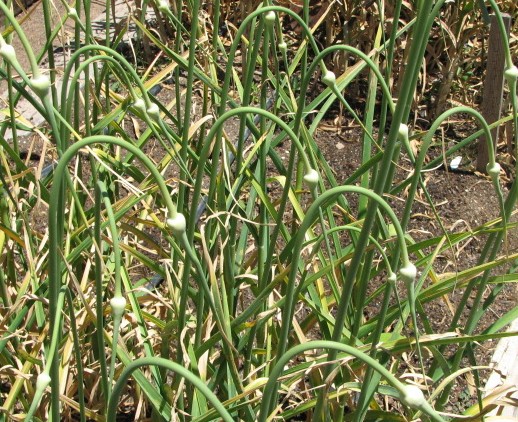
Garlic Scapes. They are all looking to the south!

This time of year you might hear about scapes.  They might show up in Farmers Markets if you are lucky.  Just what the heck are they?  Scapes are the long curly green leafless things that grow out of garlic, also known as garlic tops, garlic shoots, garlic spears or garlic flowers.  They are extremely tasty green shoots that grow from “heads” of hardneck (or topset) garlic which are usually discarded before harvesting in most of the U.S.  Garlic scapes are a versatile and nutritious culinary treasure that is valued in Korean, Chinese, Thai, Polynesian, and coastal French cuisine.  They can be hard to find if you don’t grow your own, but look for them late spring time, early summer.  They are garlicky but with a fresh “green” taste.  They can be used in any dish where one usually uses garlic but wants a brighter, more complex garlic flavor with less bite than one would get from standard garlic cloves.  Garlic scapes work well in soups, salads, stews, salsas, dips, guacamole, omelettes, frittatas, souffles, marinades, pesto, salad dressings, and stir-fry. 

Harvest garlic scapes when they are curled and the flowers have not yet opened.  By doing this you will produce a larger bulb and be able enjoy the scapes in cooking or raw.  I have found that the scapes growing in our hot climate can be tough the further down the stem, so at times I am only using the top 6- 8″ of the scape including the bud.  One little tip about watching the scapes as they grow is they will straighten when the bulb has reached full maturity.  By this time the flower will start to open.  You can also use the little flowerets before they dry out.  I like to sprinkle them over a salad or in any savory dishes.  They have a peppery taste.  Try something new!  That’s what makes growing your own so wonderful!   Garlic has such great character at all stages.

Scapes just picked for dinner

A simple but wonderful garlic scape spread can be made by chopping some up and mixing them with softened cream cheese (or sour cream) and dill. When added to mayonnaise to make an aioli, the flavor of chopped garlic scapes becomes milder and the savory notes are more apparent. Use the scapes as a great side dish.  Here’s a simple but good recipe for roasted garlic scapes.

Roasted Garlic Scapes

Take the scapes and put them in a lightly oiled roasting pan, top with salt (kosher or sea salt works best). Put the loaded and covered pan in a hot (425°F) oven for 30 to 45 minutes or until they are beginning to turn brown. serve as a side or main dish. Tastes like roasted garlic but creamier.

Garlic Scape Pesto

1 cup grated Parmesan cheese, 1/3 cup walnuts,  3 Tbsp. fresh lime or lemon juice, 1/4 lb. garlic scapes, 1/2-cup olive oil
Salt to taste

Puree’ scapes and olive oil in a food processor until smooth. Stir in Parmesan, walnuts and lime or lemon juice and season to taste.

Growing great garlic guide

3 Comments

Filed under Gardening, Recipes from the Garden

How Much Do I Water?

What's more relaxing than watering on a Sunday evening.

One question that I probably get asked the most is “how much do I water?”.  That’s really a loaded question.  With out being in your garden, no one can tell you how much to water your garden,  or flower bed needs.  Each garden has its own idiosyncrasies that must be observed.   My water needs in my garden has changed over the years.  I have built the soil up with organic matter and I have literally changed the structure of the soil.  From clay to good draining soil.   Plants need water to absorb nutrients in dissolved form starting at the roots.  If the plant is deprived of water the cells in the plant start to shrink from the tips down, burning the ends and making the plant stressed and more likely to be unhealthy.  Adequate water is essential for the plants survival. 

Get to know your soil.  Dig into your soil to find out what kind of soil you have.  It makes a big difference in your drainage.  Clay-layden soil has special watering challenges.  In dense clay , little room exists for air to pass through and reach the roots.  Clay drains very slowly and compacts easily.  This is the type of soil I have.  It took many years of adding soil amendments to get proper drainage.  I think it’s the hardest soil to work with.  When the surface seems dry, you could be drowning the roots below, so you should always stick a finger in the soil to test for moisture.  Sandy soil has other challenges.  Although the drainage is very good, you may have to water 4 times as much as someone with clay soil.  Because of the quick drainage, nutrients are lost quick too.  Both clay and sandy soils can be turned into a loam by mixing in loads of organic material, such as compost.

Keep water percolating in the zone.  The plants roots systems are the most critical area of watering.  The depth varies among plants.  In general, we are talking about the first  6 to 8 inches of the soil with vegetable gardening.  Keeping that section moist prevents the plants from becoming parched by thirst or stressed from binge drinking (giving them lots of water and letting them dry out).  With good garden soil, you should be able to squeeze a little dirt into a clump that will break up easily if you gently bounce it in your hand.

Mulch your garden to conserve water in your soil by shielding the ground from the hot  sun rays that burn off moisture.  Thick layers of mulch also helps keep weeds at bay which also rob your plants from moisture and nutrients. 

Recent transplants need frequent, light watering to accommodate for their shallow roots and ease the shock of being pulled from their pots.  Newly sowed seeds need a light sprinkle often to keep them moist so they can germinate.  Steady watering is also critical at the time of flowering and fruit formation.  For some crops, like tomatoes, yields may improve, but some flavor may be lost with too much watering as fruit ripens. With carrots and cabbages, for example, watering should be reduced as the crop reaches maturity to keep the vegetables from splitting.  Once plants are established, more harm than good is done by giving them a daily sprinkling.  We want plant roots to go deep once they are more established.  Water deeply, less frequently and the roots will go down searching for water rather than looking up to the surface for water which will cause them to dry out faster. 

Early morning, and evening are usually the best times for watering because the cooler the temperatures, the less evaporation.  These times are particularly good when using an overhead sprinkler.   Under bright sunshine, water droplets intensify the rays and can singe the leaves.  I like to give my plants an overhead sprinkle every once in a while to “wash” the dust off early morning, even though I use drip tape in my garden for my main watering.  Night time is also not the best time to water  with a sprinkler because  the leaves stay wet and that can encourage disease.  However, like my area being so arid I will turn my drip on overnight at a very slow rate to water deeply and there is little evaporation that way.

Group your plants in the garden with plants that require the same water needs.  For example, lettuce needs plenty of water and many herbs are drought tolerant.  It really wouldn’t make sense to intermingle them together.  By grouping plants with the same water needs you won’t be wasting water.

Watering pots is a whole other creature.  Pots don’t have large amounts of soil surrounding them to help keep them moist.  They are above ground and heat up quicker during warm days.  And they have better drainage.  During the spring months when the pots are newly planted the roots haven’t taken up a large amount of pot space, they don’t require as much water as they will later when the roots have grown into a mass.  Usually once a day is enough.  But come summer months, depending on the size of the pots I find that I need to water them twice a day.  Watch them closely to see what they require.  One hot day can completely wipe out some of your back porch beauties if you skip a watering

According the a common rule of thumb, a garden needs about 1 inch of water per week.  Now this can be tricky!  You have to use common sense here.  If you have had winds, your soil will dry out quicker and it may require water more often.  If you have had rain……..Turn off the water.  If your soil is sandy and it drains faster than you can say “rain”, more than and inch a week might be necessary.  The temperatures will affect the amounts of water you need.  We can reach 110 degrees here in Southern Utah for  weeks at a time and the plants will look wilted and yet they were just water earlier in the morning and the ground it’s still wet.  Plants may do this to protect themselves by exposing less surface to the sun and conserving water.  But of course, if the soil is dry, you better give it a drink so it can survive the day!

Be water wise!

Leave a comment

Filed under Gardening

Making Compost

Compost is a beautiful thing for gardeners!

If I could only put one thing into my garden it would be compost.  I have been composting for twenty years now.  When I first started to garden I would just simply put the plants into the soil and expect them to grow.  My gardens have since improved dramatically thanks to compost.  When people come to me and ask what they should do to get their garden going I always say ” compost, compost, compost”.  I think it is the first step!  Composting can be as simple, or as complicating as you make it.  I like to compost everything.  Whereas some like to add manures into the garden without composting, I will compost it first.  I feel this way I still get the benefits of the manure without it robbing the soil of nitrogen and it also kills weed seeds that I would rather not deal with later.  Composting choices are numerous, ranging from worm composting to what I call “dump and run”.  Pick a spot in your yard for your compost pile, ideally near your garden for easier access and where the sun hits it for most of the day.  You can just simply build a pile right on the ground with nothing around it, or you could use pallets, a wire fence enclosure or something of the sort to encase it for a more tidy look.   I don’t like to make composting rocket science.  For one, I don’t have the time, and two I’m not a rocket scientist!  What I have available at the time is what I use.  Water near by is a must because if it’s not…..well, we have a tendency to neglect giving our compost heaps enough water that it requires and if we have to drag a bucket it probably won’t get done.  At least that would be in my case!  One thing to get out-of-the-way and I can’t stress enough!  DO NOT use synthetic fertilizers (chemical) to heat up your pile!  Compost is made when billions of microbes  digest the waste you provide for them.  Think about it.  Would you eat a cup of synthetic fertilizer?  Of course not, because it would be lethal.  Yes, it will decompose with synthetic fertilizer, but I prefer not to add such things that will go in the garden and then my body.  Carbon, Water and nitrogen are the key ingredients.  I like to have bare earth beneath my compost to allow worms and other organisms to get into the pile.  For better drainage you can add straw or twigs for the first bottom layer.  Start layering greens (nitrogen) and browns (carbon).  Like I said I use what I have.  If I have loads of fresh grass clipping I don’t add much water, because there is enough moisture.   Add kitchen scrapes, leaves, garden waste or wood chips for layers.  When adding a new layer I like to add a handful of blood meal and bone meal.  Every layer gets a little stir. Your compost needs to be moist, not soggy to break down.  Like a wrung out sponge.  I cover my pile with burlap to help keep the moisture and heat in.  You can turn your pile every few days, every few weeks or just let it sit and rot.   The moral of the story is-everything rots.  The hotter the pile the faster it will decompose.   Chopping or shredding your materials also helps speed things up.  Water occasionally.  Nitrogen materials consist of:  grass clippings, kitchen waste, coffee grounds, eggshells and chicken manure.  Carbon materials:  dried plants, straw, newsprint, cardboard, dryer lint and wood chips.  Things you shouldn’t compost:  meat, bones, milk products, diseased plants, weeds with seed heads, walnut leaves and roots from pernicious weeds.  Some people add wood ashes and that’s okay if your soil pH is low (acid).  I don’t because our area has a high alkaline count.  If your compost is soggy and/or stinky, turn the pile to aerate and you can add some dry peat moss to tame it.  Things that I keep near my compost pile:  Pitch fork for turning, blood and bone meal, machete for chopping,  compost thermometer and burlap.   An unknown author once said; You know you’re a real gardener when you think compost is a fascinating subject.

4 Comments

Filed under Compost, Gardening

The Carrot Patch

When planting the garden, don’t forget about the carrots!  Carrots are often thought of only as a spring time planting, but I like to plant carrots though the growing season into early summer and then again in the fall.  Home-grown carrots have a sweet juicy flavor that can’t compare, thank goodness,  with supermarket carrots bland taste.  I plant closely and start to thin out baby carrots for early nibbles and roasted baby carrots.  When growing your own carrots you have so many more choices.  Carrots are diverse.  Some varieties are pencil thin and some short and stubby.  Colors go beyond the familiar orange.  Purples, white, and yellow are so fun to display on a white dish at the dinner table.  And who can’t resist eating a few straight from the ground.

If you have ever grown carrots and they each seem to have grown many legs in many directions, you can probably blame your soil.   Carrots grow best in sandy soils with good drainage.  Work in plenty of organic matter (compost).  If you have clay soil you can amend with perlite or vermiculite and peat moss.  This opens up the soil allowing your carrots to grow longer root systems.  If your soil is still being worked and is not yet loamy, don’t let that stop you from planting carrots.  Just plant varieties that are shorter like, Chantenay varieties.  They are also very good winter keepers.  Just let them stay in the ground over winter.  This is a great way to have fresh carrots all winter long without taking up space in the root cellar or frig.  If you live in a cold region put a layer of straw over them the keep the tops from getting damaged from frost.  Carrots require an open sunny site.  Sow seeds outdoors in early spring until summer.   Carrots do not transplant well.  Broadcast seed, tamp down and cover with a thin layer of fine compost.  You can also sow carrots and radishes in the same row.  Just be very careful when pulling radishes that you don’t disturb the carrots too much by pulling the radish with one hand and the other holding down any carrots that might want to come with.  Water with a gentle wand so as not to disturb the seed much.  Keep soil surface moist till carrots germinate.  I wait to thin my carrots until they are big enough to eat as baby carrots, 2-3″.  This does take away from the size of later carrots a bit, but I don’t mind a  smaller carrot.  You can thin early when greens are 1-2″ tall to 2–3″ apart.  Put thinnings into your compost pile.  Keep weeds out of your crop making sure not to disturb the roots too much.  Carrots are companions with onions and chives.  Now!  Go plant some carrots!

Roasted Baby Carrots With Honey and Rosemary   


Scrub baby carrots.  Trim off all but 1/2 inch of the greens, arrange carrots in a single layer on a foil-lined baking sheet.  Drizzle with olive oil and roll back and forth to coat.  Roast until carrots are tender when pierced with a fork, about 20-40 minutes.  remove from oven and season with salt and pepper.  Drizzle hot carrots with a little honey and finely chopped fresh rosemary.   Easy and so good!

Leave a comment

Filed under Gardening, Recipes from the Garden