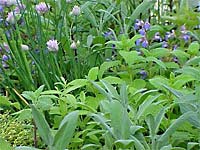
Planting Companions

In nature, where plants grow without the ground being worked, there is always a mixture of plant types growing in an area that are happy in there habitat.  The type of plants living in an area depends on the soil type and climatic conditions .  Most plants that grow together in the wild are mutually beneficial in that they allow for maximum light utilization, moisture and soil conditions.  This is what we call companion planting.  Plants have a beneficial effect on different garden plants because of some peculiar characteristic of their growth, scent, or root formation and soil demands.  Some plants that have strong orders, including those with aromatic oils, play a role in determining just which insects visit the garden.  While some plants repel, they can also hinder the growth rate of other plants or otherwise adversely affect them.  I have seen good results and not so good.  Yes, tomatoes like carrots, but you do sacrifice a little bit in the size of your carrots due to the shading that tomatoes cause.  I don’t mind because I like tomatoes more and I like baby carrots better!  I have listed some things that grow well together. 

  • Basil: Tomatoes (improves growth and flavor)
  • Bean: Potatoes, carrots, cucumber, summer savory
  • Beets: Onions, kohlrabi
  • Borage: Tomatoes (improves flavor & growth, deters tomato worm, attracts bees) squash, strawberries
  • Carrots: Peas, lettuce, chives, onions, leeks, rosemary, sage, tomatoes
  • Chive: Radishes
  • Chervil:  Radishes (improves growth & flavor)
  • Dill: Cabbage (improves growth & health), carrots
  • Flax: Carrots & potatoes
  • Fennel: Most plants seem to dislike it. 
  • Garlic: Roses & raspberries (deters Japanese beetle), plant liberally throughout garden to deter pests
  • Horseradish:  Potatoes (deters potato beetle)
  • Hyssop: Cabbage (deters cabbage moths) grapes
  • Lemon Balm: Here and there in the garden
  • Marigold:  Keeps soil free of nematodes, discourages many insects. Plant freely in the garden.
  • Pea: Squash
  • Petunia: Protects beans, beneficial throughout the garden
  • Nasturtium: Deters aphids
  • Rosemary: Carrots, beans, cabbage, sage
  • Summer Savory: Beans, onions, deters bean beetles
  • Tansy: Plant under fruit trees, deters ants squash bugs
  • Thyme: Plant throughout the garden
  • Wormwood: As a border, keeps animals out of the garden
  • Yarrow: Plant along borders, near paths, enhances essential oils in production of herbs.

Not only do these plants improve the growing, flavor and overall health, they also give your garden interest and character.  Don’t forget to add to your garden journal which plants thrived and which, not so much.

2 Comments

Filed under Gardening, Herbs

Creating a Succulent Garden Bench

Even here where the temperatures reach above 100 degrees for more than three months and winter months dropping in the teens, these succulents grow and spread across the bench cheering up a blank space in a corner of the yard.  Simply cover the seat of the bench and up the back a ways in burlap and then a layer of thick weed mat.  Burlap is more appealing to look at then the weed mat, so that is the only reason for using it.  Use a good potting soil to fill in the seat and up the back and start planting your favorite succulents.  They will fill in with time but for an instant look plant thickly.  Tuck the burlap in and around the plants to cover any potting soil and weed mat.  Water in!  I only water about 2 to 3 times a week here in the desert and no water during the winter unless we have had a complete drought.  Use Hen and Chicks,  Dragons Blood Sedums,  Stonecrop and anything available.  Once they start to crowd out, thin out and share with a friend for their new bench.

Leave a comment

Filed under Garden Whimsy, Gardening

Putting My Backyard to Work

When we moved into our home 23 years ago this coming July I never imagined I would be integrating so many things on our little 1/4 acre.  I soon filled our plot with a garden, fruit trees, shade trees, grass and flower beds.  I quickly ran out of room!  We had an adjoining lot that was a 1/4 acre also and it had been vacant since we moved in.  After filling up our little plot I soon decided to plant a small garden, 4 ft wide by 50 ft on the edge of that  lot.  And yes, of course it did indeed go up for sale. Isn’t that the way!  We never planned on buying that lot and soon found out we were destined to own it.  And that’s where it all began.  My husband brought home 3 baby chicks from the local feed store and that opened the doors.  Soon to follow were more chicks, ducks, goats, rabbits,bees, 2 cats, a dog and now even a small cow.  An orchard of 35 fruits trees were to start us off on that 1/4 acre lot now 48 fruit trees dwell within. 16 grape vines, a greenhouse, berry patches, cold frames, compost bins, chicken coop, barn, garden and a small retail cottage organic garden business all within that small 1/4 acre lot.  My husband probably wonders “what if” he didn’t bring home those 3 innocent chicks that April day.  I’m sure he never planned on such a life.  Just three chicks for the kids and a few eggs. 

We have been organic for 15 years now and found this is the only way to grow in harmony with our land.  Our garden, orchard and animals are defiantly work, but I can’t think of anything more rewarding in my life.  Today the “Urban Farm” is being more than just a way to supply your family with fresh produce, but it’s a becoming a movement I think we should all try!

Leave a comment

Filed under Chickens, Gardening, Goats

Making Hypertufa Pots

Small Hypertufa Pot

Making Hypertufa Pots

So what exactly is Hypertufa (which is pronounced hyper-toofa) Well Hypertufa is the name for an artificial stone. It is used to make a substance similar to the natural volcanic rock called Tufa. Tufa is used to make planting troughs, bird baths, and other things but has become a difficult rock to get.

Hypertufa started being used in the mid 19th century by mixing sand, peat, various volcanic aggregates and cement. It is much lighter than stone or concrete and can withstand cold winter temperatures and blazing summer heat equally well.

Since most Tufa deposits have been depleted the Hypertufa mixture is becoming more and more popular. This mixture also has the advantage that it can be molded and carved into any shape that you want.
1. Wearing rubber gloves and a dust mask to avoid breathing cement dust, mix 3 parts perlite, 3 parts peat moss, and 2 parts Portland cement in a plastic tub. If desired, add cement pigment for color. If making a large pot, add acrylic fibers or chicken wire for strength.

2. Add water to tub, a bit at a time, until the mixture has the consistency of moist cottage cheese.

3. Line Mold with a plastic bag for ease of removal.  Placing leaves or sticks around the outside of the mold before putting in the mix will give texture to your pot.  Spray inside of mold with cooking oil. Push a handful of wet hypertufa mixture firmly against the bottom of the mold. Repeat until you have made a bottom base that is approximately 1 inch thick. Push handfuls of wet hypertufa mixture firmly against the sides of container approximately 3/4 inches in thickness. Continue until rim of mold is reached. Press bottom and sides firmly to remove air pockets.

4. Create drainage hole by pushing finger or small dowell through the bottom of mold so that it penetrates the hypertufa mixture.

5. Cover with plastic bag, let dry for about 48 hours, depending on the weather.

6. Take off plastic bag and remove pot from mold (pot with be slightly wet). Handle with both hands to assure you don’t break the pot.  Using a wire brush, stick or sandpaper, rough up the surface of the hypertufa for a more rustic appearance. Let sit for 2 to 3 weeks to dry completely.

Leave a comment

Filed under Garden Crafts