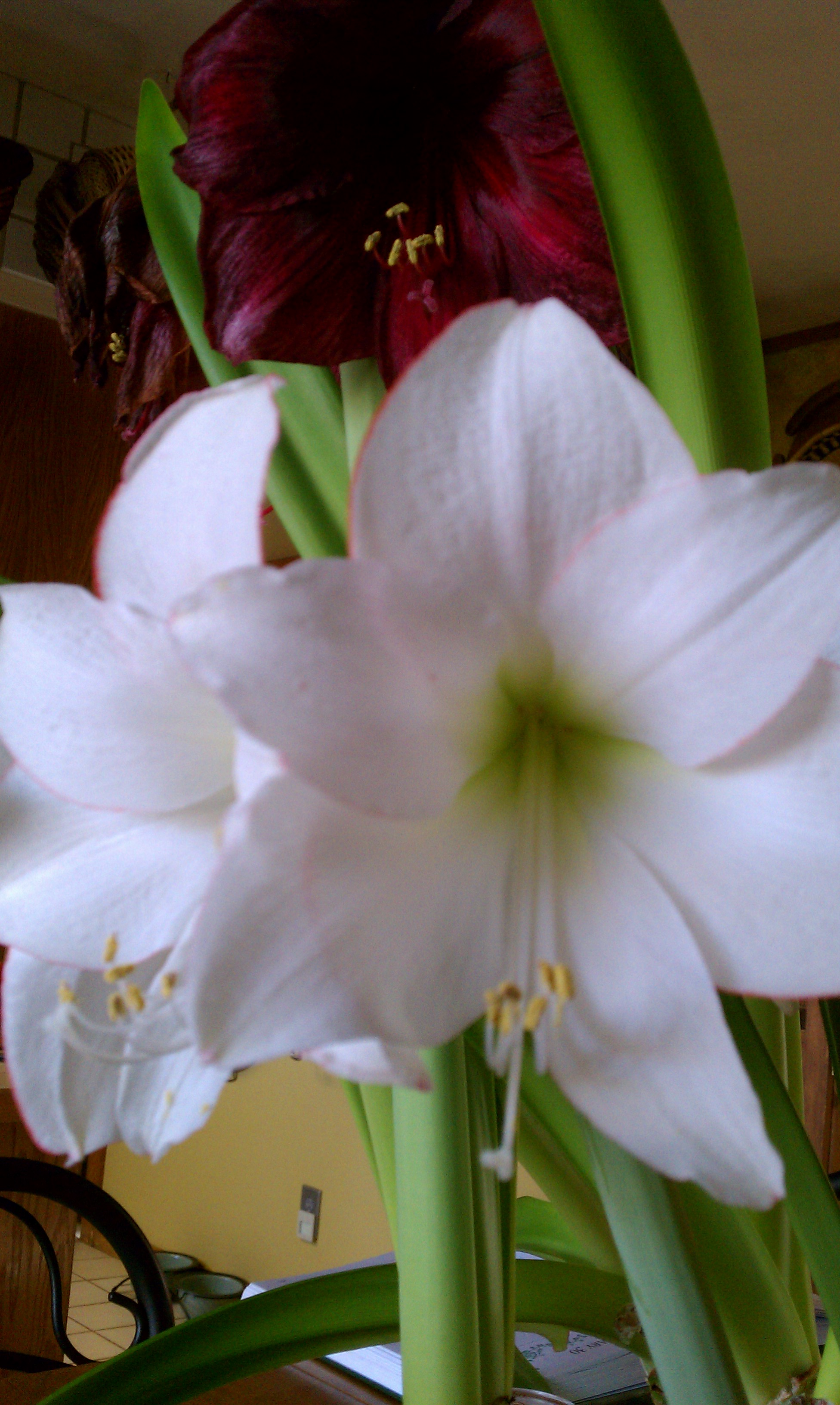
Many of us around Christmas time plant these big beautiful bulbs. Caring for them and getting them to bloom is fairly easy and we enjoy the show. But what happens to these bulbs after blooming time. Some will toss the bulbs just because they don’t know what to do with them and some, more than likely the gardeners in us will save them trying to get them to bloom again. Unlike most forced bulbs, Amaryllis can bloom again and again if we take the proper steps. Fertilize with a well-balanced fertilizer once a month until early autumn. If you have your plant outside during the warm months bring it in before frost. Stop watering the potted Amaryllis. Cut down the foliage, uproot the bulb from the planting medium and store it in a cool, dry, dark place for eight to 10 weeks. They need a nap! I like to keep them in a brown paper bag in the cellar. After nap time, it’s time to replant the bulb in fresh potting soil. Water thoroughly, fertilize and in no time you will have new leaves emerging with blooms not far behind ready to bloom.
Category Archives: Gardening
Amaryllis Year After Year Show
Filed under Flower Gardens, Gardening
Making Your Garden’s Dirt, Living
When I first started my garden years ago I can honestly say it was definitely dead dirt. Nothing living in it at all except the local gopher. Not even a worm. Soil should have life and lots of life to it to make healthy plants. It all starts with the soil. From the ground up. One thing I have always have said is “Feed the earth that feeds the plants that feed you”. Healthy soil wards off diseases and insects. When the plants are healthy they have less chance of becoming weak and diseased. Just like us human beings. Insects will always go to the weak plants first. Healthy soil means that organisms in the soil are present and doing their job to support the growth of plants. There is microscopic life performing its own function in the soil food web. There is good bacteria, which requires oxygen to survive while the disease-causing bacteria thrive on low-oxygen. Makes since! Think about compacted soils verses loose loamy soils. This was my story when I first started my garden. Believe it or not good soil contains Fungi, microorganisms that help hold soil particles together and improve soil structure. These little buggers consume things like pine needles, branches and leaves. Larger hard to break down materials. So you can see that having both these good guys are more than valuable they are essential. Nematodes are something else in the soil you may not associate with as being good. Most people think of root-feeding nematodes that cause havoc while the beneficial nematodes help protect the roots from disease and build soil structure.
So this brings me to Organic Fertilizer vs. Synthetic. Natural or synthesized. While many people have had success with synthetic, overtime they are destroying your soil. Killing off any good microorganisms, not to mention run off and leaching into our water tables. Synthetics do not feed the living organisms while organic soil amendments and fertilizers do. synthetic chemicals leave your plants without beneficial life which is their support system! Yes, organic is bulkier, but in the long run your soil, plants and your body will thank you! synthetic is a quick fix, but is it? The chances of burning are higher. The salt content is higher. Organic fertilizer is a slow release and gives gardeners a litter more leeway to make mistakes without seriously harming the soil or plants.
If you are starting a new garden spot, you need to know your soil. Is it clay or sand? Loamy? Silt? But what ever you have the very first thing I would add is compost. Not just a little compost, but a lot of compost. Every time you plant! Every Time! Make sure your compost is truly composted. Sometimes people think that compost means just manure. Don’t think that this is compost. It is raw material that will take time to break down. If added and then planted right away it can burn new plants and seeds may not germinate. Raw material will also rob your soil of nitrogen. I like a well-rounded compost made from more than just manure. Add peat moss or coconut coir, depending on your pH. High pH, add peat. Low pH add coconut coir. If your soil is sandy add some vermiculite to help hold the water. If it is clay, add perlite to open up the soil for better drainage and help the good bacteria. These three things, peat moss, vermiculite or perlite and compost can be used for raised beds, but make sure you add some good old dirt to the pile. I really have seen much better results when you add your native soil to the mix. Peat will last for 4 years in the soil and vermiculite and perlite will last for 5-7 years. Another important soil amendment that you shouldn’t forget is Greensand. Greensand supplies no organic matter, but it helps loosen clay soils, improves water and nutrient retention in sandy soils, and is a rich source of potassium and micro-nutrients. I put it in my soil every spring when preparing my garden beds. As far as working the beds with a tiller I am all for it! BUT, please don’t pulverize your soil. Less is more in this case. I like to work my amendments into the existing soil, but not overwork it. It really isn’t good for the worm life. I use a small tiller in my raised beds and the tines only go 8-10 inches deep, so every 3 or 4 years I deep dig (great cardio exercise) with a shovel below the point of where the tines go. The soil gets somewhat of a hard-pan that isn’t healthy for your plants. Add organic fertilizers to the needs of your plants. I suggest to use less more often then loads less often. The plant will react better and will be healthier if you do it this way.
There are so many things you can add to your soil to help improve its structure and tilth. Weed free straw, leaves, leaf mold, cotton burr compost, shredded pine needles and so many more things. I like to add these in the fall so they have time to break down through the winter. Work them into the soil. Another thing that some people really like and I use it as well, but I always compost it first is shredded tree branches. If it hasn’t been composted first it will inhibit seed germination and seriously rob your soil of nitrogen.
There are a few amendments to really feed your micro organisms if you want to get them really active: Crab Meal, Neem Seed Meal, Karanja Seed Meal, and Alfalfa Meal. These are great in the compost pile too for basically the same effect.
Growing Kohlrabi
Kohlrabi is a crop that gets over looked. It’s an under loved plant. Why? Because most people, gardeners have never tried it, or don’t really know what it is. I will have to admit that I saw it for years in the seed catalogs and always passed it over. It just seemed odd. Kohlrabi is on of the easiest of the brassica family to grow. It is also known as a German turnip. It can handle temperature extremities better than its family members and it can be pretty unique looking in the garden. Often times you will see it listed with root crops, but this baby grows its spherical bulb above the ground. Kohlrabi can be boiled, mashed, and served with butter, made into fritters or added to soups and stews. It can be eaten raw just like an apple, or sliced and tossed into a salad. My favorite way to use kohlrabi is to replace it with the old standard ‘cabbage’ in cole slaw recipes. It has a delicate, slightly nutty flavor, kinda similar to a turnip, only better and it is an excellent source of vitamin C. Some even use the leaves to steam or in green drinks. Kohlrabi usually takes only six to eight weeks to mature. Often times I intercrop it with Brussel sprouts as it requires the same conditions as other brassicas and it will be long gone by the time the Brussel sprouts need the space.
I start to plant my kohlrabi the end of January here in Southern Utah and will continue to plant through the middle of March. White/green varieties for early sowing and purple-skinned varieties, which are hardier, tolerate the heat better, later in season. Kohlrabi prefers rich, moisture-retentive, free-draining soil. When transplanting your starts into the ground I always add Bio-Fish nutrients, about 2 T in the hole where each new little plant will go to give it a boost. Always mix in your nutrients/fertilizers with the soil in the hole so you don’t have direct contact with the roots and the fertilizer. I always use organic fertilizers because they have less of a tendency to burn new transplants and they are slow release, but regardless of what you use, it’s a good habit to get into when adding fertilizer. Firm in your transplant! Firm it in! Brassica likes to have a firm foundation. Not bad, hard soil, just firm around the plant. Give a slight tug on a leaf, if it comes up, it isn’t firmed in enough. I like to space my plants about a foot apart. Water in well and keep your soil evenly moist for the duration of the growing period. If your bulb cracks, it was probably because of water fluctuations. To much water, then not enough. Fertilize again at three weeks with Bio-Fish, or use a liquid fertilizer. Keep weed free. Weeds only rob your plants of nutrients. Dirty buggers! Pick kohlrabi when it is about the size of a golf ball, but no bigger than a billiard ball. Just simply pull from the ground and toss the leaves and roots into the compost. If you are growing closely to other plants and pulling the plant up will disturb nearby companions roots, then just cut it off at ground level. 
Kohlrabi can be grown in the fall time to. I start seeds in mid-July and plant by late August having a harvest at the end of October. If you live in a mild climate where the summer temperatures don’t go above 90 degrees for weeks at a time you can grow it during the summer months to.
Filed under Gardening
Have You Ever Grown a Fava Bean? Would You?
What the heck is a Fava Bean? For the last several years I have added this delicious legume to my garden. Not only is it great to add nitrogen to the soil, very cold hardy, but it is very nutritious as well. Fava beans are one of the oldest plants under cultivation, and they were eaten in ancient Greece and Rome. Fava beans are in the pea family, even though their name suggest they are a bean. This is why they are cold hardy unlike other true beans. They are popular in Mediterranean cuisine with a distinct creamy flavor. You can eat them fresh or dry. Dried they store well and can be added to soups or any bean dish. Fresh, they can be added to salads and pasta dishes. Fava beans are great steamed and served with olive oil, salt, and lemon.
Fava beans do not tolerate hot temperatures, therefore plant them as soon as the ground can be worked in the early spring or in my case in USDA zone 8, late winter, January to be exact. Fava bean can be planted in heavy soil as long as there is good drainage and the soil has been amended with compost and a well-balanced fertilizer. Fava beans will improve your soil, so it’s a good idea to plant them in less than perfect spots in the garden. Soak the seeds a few hours before planting to help with germination. Plant 1 1/2 – 2″ deep 6-9 inches apart. I like to stake my fava beans with some old branches 2-3 ft tall stuck into the soil on either side of the plant. Usually this is enough unless we have high winds, then a little hemp twine around the plants and stakes will do. Fava beans are usually ready in 4-6 months to harvest. You will be surprised how neat they look in the garden. The beans grow on bushy plants with tapering leaves, yielding anywhere from 25 to 50 pods per plant. The pods resemble pea pods in shape, although they are much larger and lined with a pillowy white material that protects the seeds inside. Give plenty of water throughout the growing season. Pinch off the tops of the plants when the first pods have begun to form. This aids pod formation and discourages blackfly. Pick the pods when they have become swollen. You can see a slight definition of each bean inside the pod. Do not allow the pods to be too mature because they will become leathery and tough. Continuous harvesting will extend the crop season. Broad beans (another name for fava) are beast picked and used fresh. Any extras can be frozen or dried.
Once your plants are tired, retire them back into the soil. You may need to chop them up a bit, but you can just till them in or add them to your compost pile. Whatever you choose, don’t toss them into the trash. These guys are valuable! The smaller the pieces the faster they will decompose. Favas are commonly used as a cover crop. They are big nitrogen fixers. Now why wouldn’t you grow these beauties?
Quinoa, Avocado and Fava Been Salad
1 cup quinoa, 1 lb shelled fresh or frozen fava beans, 2 med. lemons, 2 ripe avocado, 2 garlic cloves, 2 bunches of breakfast radishes halved lengthwise, 1 cup purple basil leaves chopped, 1 T ground cumin, 1/3 cup olive oil, 1/4 tsp chili flakes, salt and pepper to taste.
Cook quinoa and rinse with cold water and leave to dry. Toss fava beans into a pan of boiling water and boil for 30 seconds and immediately drain in colander and leave to dry, then press each bean with your fingers to remove the skins and discard these. Take the lemons and use a small sharp knife to slice off the top and base. Stand on long end and cut down the sides, following the curve to remove the skin and white pith. Over a large mixing bowl, cut in between the membranes to release the individual segments into the bowl. Squeeze the juice from the membrane into the bowl with the segments. Peel and stone avocados. Slice thinly, then add to the bowl and toss to cover in the lemon juice. Once the quinoa is dry, transfer it to the bowl. Add the fava beans, garlic, radishes, half the basil, cumin, olive oil, chili flakes, and salt and pepper to taste. Toss gently and garnish with remaining basil. Great Healthy Spring Recipe!
Filed under Gardening, Heirlooms, Recipes from the Garden