Joe-Pye Weed, The Overlooked Fall Bloomer

Years ago when we put up our first greenhouse, I wanted to start every herb I could get my hands on from seed. Joe-Pye Weed was agonizing. I could never get it to germinate. Perhaps the seed was old. Year after year I would buy more seed only to fail over and over. On one of our vacations we stopped at a small nursery in Moab Utah on the way home and there it was! Joe-Pye Weed! It was towering out its one gallon pot with its huge pink flower heads. I was in love and of course it come home with us along with many other plants from cute little nurseries on our travels…. And now that I have my specimen, I have no problems starting it from seed.

A little history; Joe-Pye Weeds botanical name is Eupatorium. It is also known as Boneset, Purple Boneset and Gravel Root. The King of Pontus, Mithridates Eupator discovered the use of this plant as a medicinal tonic and it was named after him, “Eupatorium”. Joe-Pye, its common name comes from the name of an Indian name Jopi who used it medicinally as well. It has been used to relief pain of the fever, break-bone fever, to fight typus, to dissolve kidney stones and an affective diuretic. Its quiet bitter to taste.

The roots are the parts used for making tinctures and can be harvested at anytime, but it’s best harvested in the late fall for the strongest qualities. Harvesting should be done after this perennial has been in the ground for two years.

Joe-Pye Weed is easily grown in full sun, moisture-retaining, but well drained soil. When grown in a shady spot it can get floppy. It is an excellent showy fall blooming plant that should be grown in the back of flower beds, reaching over six foot tall. It pairs beautifully with Snow on the Mountain and Goldenrod. Moderate fertility is enough to feed this awesome performer. Joe-Pye Weed does better when the soil isn’t allowed to dry out. It can be become rather scruffy and tattered looking if it doesn’t get enough water. It forms huge flower heads ranging from a light pink to a deeper rose-purple depending on the variety.

This plant is not flashy as a small immature plant in pots. We grow this every year for our nursery and most people snub it off. Perhaps it’s the name that has “weed” in it that turns their noses, but come summer time and they see it in our demo herb bed, most everyone says with great excitement, “what is that plant?”.  It’s not a weed or invasive so even if you don’t have typhus or kidney stones, but have a sunny location, you might want to give Mr. Joe-Pye Weed a spot in your landscape!

Leave a comment

Filed under Flower Gardens

Love Those Perennials!

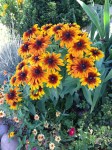
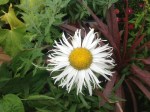
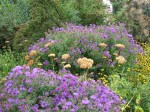
I love perennials and this is the time of year most of them are bursting with color!  Unusual Rudbeckia, Salvia and Echinacea are some of my most loved sun perennials.   Perennials are considered  low maintenance plants, but as any perennial gardener knows, this does not mean no maintenance.  The biggest plus side is you don’t plant them every year, they last for years and they get better and better as they become more mature.

Most perennials need food, water, dividing and deadheading to keep performing well.  Perennials can be planted in the spring or fall when the weather is kinder to transplanting.  When planting them, amend the soil well with compost and add a couple of tablespoons of fertilizer (preferably a slow release organic fertilizer) in each planting hole.  This gives them a good jump-start.  Keep them watered well to begin with.  They need to get their roots established before they can withstand fewer waterings.  Some are more drought tolerant then others, so read your tag and let the plant tell you what it need.

Make sure you plant your sun loving perennials in the sun.  Several years ago I planted a beautiful sun-loving perennial bed loaded with beautiful plants like Joe Pye Weed, Echinacea, Hardy Hibiscus, Rudbeckia and others.  The trees have now grown up and the bed has become very shady.  These sun lovers are now lanky and have small blossoms.  They need their sunshine to thrive.  Later this fall these perennials will be lifted, shared, re-potted and…..probably put into a “new” sunny perennial bed.  As my husband would say “imagine that, another flower bed!”.

The same thing goes for shade perennials.  When shade plants are planted in too much sun,  the leaves burn, plants will stress and possibly die.  Here in our hot climate, if the tag says part to full shade, I will always put in full shade.  The intense sun rays will burn the plant in the middle of summer even in the morning.  Shade plants don’t have huge blooms.  They are generally more subtle, being smaller in size and not as bright with a few exceptions.  But you I can’t imagine not having plants like Heuchera or Hostas.  The whimsical airy flowers are slightly fragrant and charming.

Deadheading……..arggg…..Yes you should do this if you want BIG blooms.  When a perennial flower is left it will produce seed.  Producing seed takes energy.  Energy that is need to produce more flowers.  Unless you are wanting to collect the seed you should deadhead.  In other words, cut off the blooms that are past their prime.  Don’t just cut the top of the flower off leaving an unsightly stem, cut it off just above a leaf.  I prefer to cut down further where there is a bud.  I found some great little scissors that are perfect for deadheading.  Here is a link to check them out.  They are sharp and they spring back making it easier on your hands.  While this may seem tedious, if it’s done on an evening garden stroll weekly it can be conquered rather quickly in a few short minutes.

After the perennials freeze, cut back the dead growth about an inch above the soil level.  I like to spread a layer of mulch or compost for winter protection.  This acts a an insulator for the roots and lessens the chance of damage to extreme cold weather.  I have found my perennials come back healthier and sooner in the spring when I do this.

Keeping my perennial beds pretty in the early spring is easy!  While most of my perennials are sleeping,  I still have plenty of spring color splashed throughout the beds to keep spring bright and beautiful.  Pansies, primroses and bulbs are a bright and cheery site while the later bloomers are just peeking through the ground.  By the time the pansies and bulbs are finished for the season the perennials take a bold stand and bloom through the summer into the first frost.

Perennials are usually found abundantly in the fall as established plants.  Look for rich healthy growth and get them in the ground and enjoy them for many years to come!  Now, I’m headed out to do some perennial maintenance of my own!

Leave a comment

Filed under Flower Gardens

Growing Your Own Fresh Figs and Using Them

I have to admit that I was never fond of figs until about 10 years ago. But, the silly thing is I never knew why! How could I have not have liked figs if I never tried a fresh fig. Heck, I liked fig newtons! I even planted a fig tree in my orchard. Okay, so I am a stubborn creature…. Luckily I finally gave them a whorl once the tree started to produce and now it is one of my favorite trees in the orchard.

Figs are a Mediterranean plant. They are hardy in Zones 8 to 10, but can be grown in pots that can be brought in out of the harsh cold winters or planted on the south sides of buildings for extra winter warmth and protection from harsh winds and should be bundled with a thick layer of hay or straw and burlap. A properly wrapped fig tree should survive winters even down to Zone 6 sometimes colder. When temperatures drop below 10 degrees Fahrenheit without proper protection, figs will be lost to the cold! Moral of the story is, if you live in zone 7 or lower and you are not good at doing protective covering, you might be better off planting figs in containers.

There are over 200 fig cultivars grown in North America with a wide range of color and shapes. Most figs are self-pollinating, outside of a few odd balls, so no need for a pollinator! I have grown several varieties here, but have found my favorites are Black Mission, Kadota, Brown Turkey and Celeste. These cultivars do well here and are full of flavor.
Figs will fruit two, seldom three, different times during the season on new wood. The first starts here in June, giving off the biggest best fruits and the second is late summer. Although the second harvest is smaller fruits, it always seems to last a little longer in the season sometimes continuing a month. Many times in mid to late September new fruit starts to set. Because of the cold weather they tend to grow slow and rarely do they ever mature unless we have a very late frost.

Luckily for us, figs like a more alkaline soil and lots of sun! If you live were the soil is more on the acidic side, apply lime around the base of the tree. Keep figs well watered during the fruiting season to assure proper ripening and larger fruit. Apply rock phosphate around the base of the tree in early spring and mulch with plenty of compost.

I was told once to dip my finger into olive oil and coat the bottom of each fig to hasten the ripening. Well, when you have thousands of figs on one tree, that hardly seems sensible, but for potted figs, I can assure you, it really does the trick! The figs touched with olive oil mature and ripen ahead of others.

Harvest often! The warmer the weather, the faster they ripen. Figs will become soft to the touch when ripe and sometimes the skin will begin to split. Know the color of your figs while some are a light golden-green and others are dark brown or blue/black when ripe.

As far as pruning figs, Keep the suckers that sprout at the base of the tree and any suckers that form from the roots. Keeping fig trees open makes them much easier to harvest the fruit. Figs will grow rather informal, so prune to keep under control and open. Keep dead and damaged branches removed. Figs can be espaliered, but you have to keep on them all time to manage a good-looking espalier tree.

Figs are generally disease and insect free. Our biggest problem is ants that climb up the branches to feed on the fruit, but a layer of wood ashes keeps them at bay. Birds can be a serious pest problem. Once they taste the ripe fruit, well they are on it like BIRDS! Netting works well for smaller or containers figs trees.

What to do with all those figs…..Figs will spoil rather quickly. Making a puree out of figs by simmering them with a touch of honey and lemon for 20 minutes then running them though the food processor and freezing them makes a great filling for cookies like fig bars or it can be spread on toast.
Dehydrating them is a super quick and easy way to preserve figs for winter snacks, or even chopped up and put in whole wheat breads.

Carmel Candied Figs

Fresh Black Mission Figs

Fresh Black Mission Figs

Left over fig juices

Save the left over fig liquid reduce with balsamic vinegar for balsamic vinegar.


A friend of mine shared a recipe with me this year and I have enjoyed it more than anything I have done with figs. It’s called Carmel Candied Figs. While it takes days to make, it is a very easy process. Day One; Place 6 pounds of figs in a heavy stock pot, adding 1 cup honey, 1 cup water and simmer with a lid on for 1 hour. Swirl the liquid, but don’t stir the figs or they will tear. Let sit overnight. Whole spices can be added like, cinnamon, star anise or allspice, but it is not necessary at all! Day two; simmer figs without lid for 1 hour. Let sit overnight. Day Three; simmer figs without lid for 1 hour. Cool. Line 2 cookie sheets with parchment paper. Place figs, stem up, flattening slightly on cookie sheet and place in an oven with pilot light. Turn figs over, belly side up, the next day, turning a few times a day from stem side to belly. do this until figs are chewy. It usually takes about three days, depending on the humidity. I store mine in glass containers with a lid, but leave the lid ajar for a week to remove any extra moisture. Extra moisture will cause mold….You don’t want that to happen. They can also be frozen at this stage. These delicious figs can be eaten like this alone or can be added to fall breads, muffins, scones, custards or whatever you set your mind too!  TIP:  Save the left over liquid form cooking the figs down and add to two cups of regular balsamic vinegar, reduce by simmering for several hours.  Here is your own fig vinegar for making the best salad dressing you’ve ever had!

4 Comments

Filed under Fruits from the orchard, Preserving

Flavored Vinegars

When summers bounty is at its peak, I seem to get the urge to create my own concoctions. Whether it be preserving my harvest a little different then last year or just trying something new for the dinner table. Flavored vinegars are always on the to-do list to add a distinctive flavor to foods from prosciutto salad to bulgar wheat.
You can buy some pretty bottles or reuse old vinegar or small neck bottles to keep you vinegars in.
Raspberry vinegar is probably one of our favorite flavors. We use it as a salad dressing when mixed with a little olive oil. It’s also very delish when used with pomegranate salad. Use either red wine vinegar or white wine vinegar for best flavor. Combine 1 1/2 pints of wine vinegar, 4 T sugar and 1 cup of raspberries. Simmer for 15 minutes. Can be reduced to intensify the flavor. Strain the mixture through a fine sieve and pour hot into a sterilized bottle.
Herb vinegars are probably the most popular. You can pick any herbs fresh from your garden. Herb vinegars release all their stored aromas. Bring 4 cups of cider vinegar to a simmer and add a handful of chosen herbs. T

urn off heat right after adding clean dry herbs and leave to cool and then strain and pour into a sterile bottle.

Rosehip Vinegar

Rose-hip Vinegar

Have you ever thought about using lavender or nasturtiums to make flavored vinegar? Prepare the same way as making herb vinegars.
If you are looking for something special to liven up a melon and prosciutto salad, try making rose-hip vinegar. Not only is it beautiful on the counter, but it adds a great zing. Heat 4 cups of cider vinegar, and 4 T of sugar until dissolved. Allow to cool. Thread rose-hips and orange peel pieces onto a skewer alternating. Place skewer into a sterile bottle and pour in the vinegar. Cap off and let sit for at least two to three weeks for flavor to become infused.
These vinegars should be used within a year of making.  Just in time for a new season and preserving!

Leave a comment

Filed under Preserving, Recipes from the Garden