Kelp and Its Many Uses

Kelp is derived from sea plants and is completely sustainable.  It grows quickly in the oceans along the shores.  Kelp comes in a liquid, powder or pellet form. Although kelp fertilizer contains only small amount of N, P, and K (highest in Potash) but adds valuable micronutrients, growth hormones (of course natural), and vitamins that help increase yields, improve soil structure, reduce plant stress from drought, and increase frost tolerance.  Kelp also increases resistance to pests and diseases.  It just simply makes plants healthier.  It can be applied directed into the soil or as a foliar spray.  All seaweed products are good for supplying major and micro-nutrients, but kelp seems to provide even more benefits over other seaweed products.  It supplies over 50 minerals. Kelp Meal is a perfect compliment to organic gardens, and is suitable for all crops.

A FEW KELP MEAL TIPS:

Easy kelp meal tea:  ¼ cup of kelp meal to 1-gallon water, let steep for 1-3 days and agitate daily.

Use kelp meal tea to drench plants before transplanting to help with transplant shock.

Use kelp meal tea as a soak for garlic 1 to 2 hours before planting.

Soak Asparagus Crowns in a kelp meal tea 1 hour before planting for healthier roots.

Sprinkle a small handful of kelp meal early in the growing season around and on the base of squash plants to help deter squash bugs.  Do this every 10 days where squash bugs are a problem.  You have to stick with it, but it really does work!

Use liquid kelp as a spray to increase yields by promoting bud formation, overall health, and to slow transpiration.  We sprayed out tomato plants this spring every 10 days and saw a BIG difference!

Use liquid kelp over dry kelp meal on stressed plants for quicker absorption and response.

Use liquid kelp as a foliar spray to help protect plants from cold and hot temperatures.  I personally think it coats the plant!

For vegetable gardens and flowerbeds Apply Kelp Meal at 1-2 pounds per 100 square foot and mix into the top 3” of soil.  For transplants, add 1 teaspoon per hole and mix with soil and water in.  To feed established plants, side dress 1-2 teaspoons per plant 1-2 times throughout the growing season to promote plant growth.  For container and houseplants: for new plantings, mix ¼ lb. per cubit foot of soil.  For established plants, side dress 1-2 teaspoons per gallon of soil 1-2 throughout the growing season to promote plant growth.

I have use Kelp Meal for years in my garden and I would have to say Kelp Meal is indispensable in my garden!

Garden Kelp Meal

Dry Kelp Meal

Leave a comment

Filed under Garden Bugs, Gardening

Whole Roasted Onion

We plant hundreds of onions, all around the perimeters of our raised beds, perhaps, too many onions, but none the less they do get used almost daily with a little creativity.  I am not one that can take a bite of a whole onion, but a whole roasted onion is another story!  Yellow onions are perfect for roasting.  Walla Walla, Sweet Spanish, Cippolini are among my favorites.

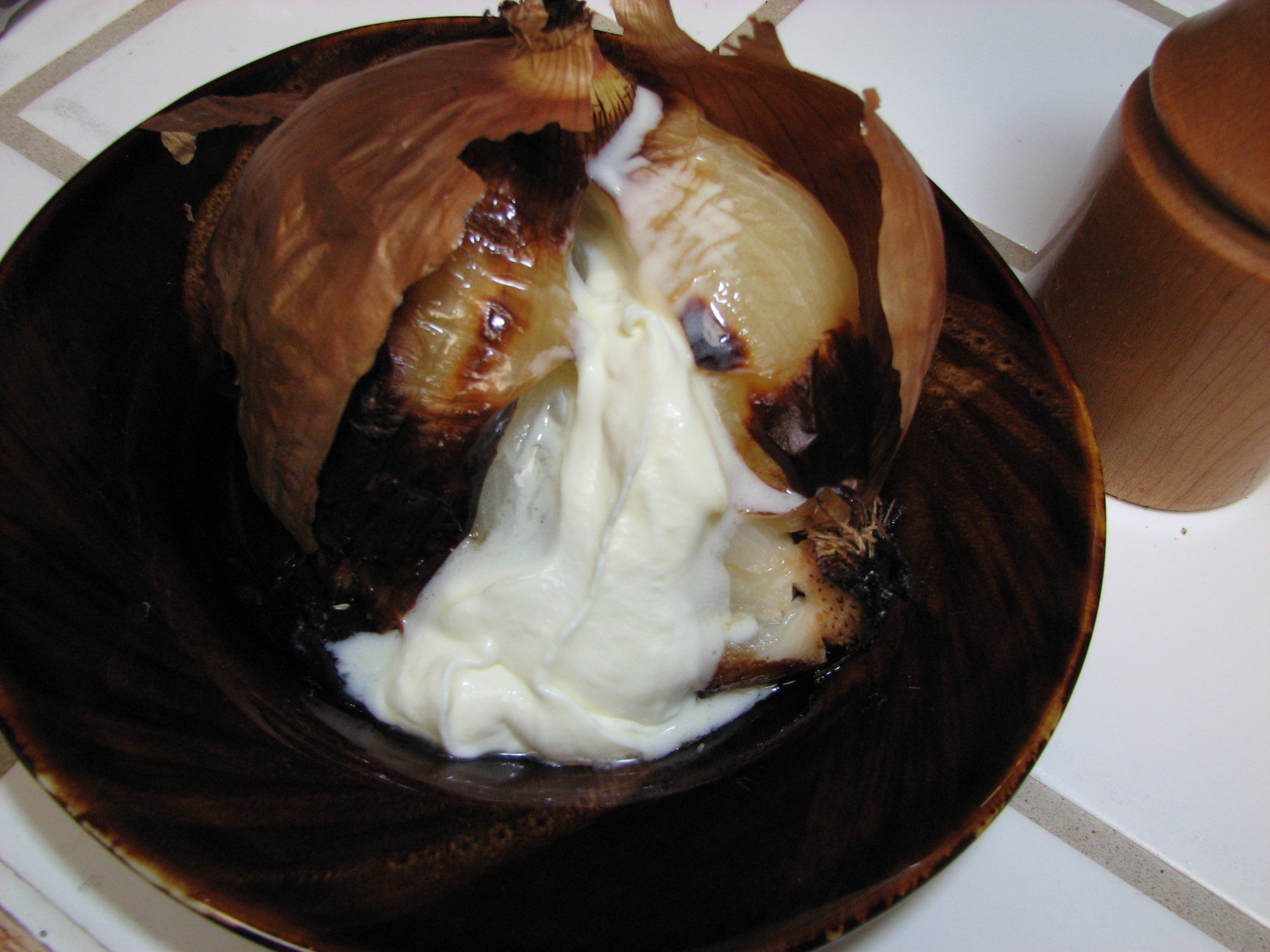
Roasted Walla Walla Onion

Preheat your oven to 425 degrees, Roast whole, unpeeled onions on a baking sheet for an hour or longer, until the skins are deep golden brown and blistered and the flesh is very tender throughout when pierced with a knife.  Slit across the top of each onion with a sharp knife and insert a pat of butter and/or a spoonful of creme fraiche.  Add sea salt and pepper to taste.

Creme fraiche is not available at our local grocery stores, so I make our own very easily by whisking 1 tablespoon buttermilk with 1/2 cup heavy cream, preferably non-pasteurized.  Cover and leave it out on the counter for 24 to 48 hours, until it thickens.  A bit of clear liquid will separate, just pour that off and whisk again before serving.  Creme fraiche will keep for several weeks in the refrigerator.

Leave a comment

Filed under Recipes from the Garden

Ginger Root

While visiting Hawaii while my son played violin, or fiddle as he would prefer, with a group of violinist performers at several locations I had the opportunity to visit a botanical garden and acquired two healthy roots (along with multitudes of tropical seeds)

Blue Ginger Flower

that would become residents in my greenhouse, grow, bloom and be harvested. While Ginger is a tropical plant I have found I can grow it in a pot quit easily and harvest beautiful roots, propagate and have a fresh healthy addition to our morning carrot juice ritual.  I have tried growing it outdoors, directly in the garden from ginger root pieces  I ordered or got from the grocery store without luck. Of course,  many times the grocery store ginger has been gassed to make it last longer and delay sprouting.  Granted, I am now a better disciplined (I water better) gardener these days, but I feel like growing in pots is the way to go in our zone 8.  I can sum what control the growing environment, protecting it from the freezing temperatures during the winter and the summers scalding hot rays.

Ginger has creeping, branched rhizomes growing near the surface, with pale yellow flesh beneath a thin, buff colored to dark brown skin that looks like knobby fingers and are often referred to as “hands”. The stems can grow up to 4 foot tall. They flower twice a year in my greenhouse. I have two varieties, one is a Blue Ginger which has a beautiful blue bloom and the traditional white flint ginger. It is said that the flowers are short-lived, but my Blue variety will bloom for a couple of months.  Many times when we take things out of their natural growing environment, they tend to ‘go against’ what they are suppose to do.

If you can get your hands on a ginger rhizome, plant it in a 5 gallon pot, just below the surface, water and give a dose of liquid fertilizer. You can grow outside during the frost-free months and bring in your pots during the winter months. Keep in a south window. However, it will do much better in a heated greenhouse where the humidity is high. Feed with a liquid fertilizer every three weeks during the growing season. Generally this would be from spring to fall. Once your root really starts to take off and the rhizome grows, which is about 7 months after planting, harvest can start if your ginger plant is happy. Rhizomes are best when harvested in the fall. Lift rhizomes carefully, take the outside pieces and leave the main ‘center’ root to continue growing and producing the following fall. Fresh ‘root’ can be stored in the refrigerator for several weeks wrapped in a breathable vegetable bag.

Ginger has been used for centuries for many medicinal qualities from travel sickness to gout to stimulating circulation.  When I was a little kid I remember my grandmother always buying me ginger-ale to simmer a stomach ache. You can make a healthier drink without the carbonation with fresh ginger root. Take about three pieces of fresh ginger the size of your thumb, chopped and put into a tea strainer or cheese cloth tied up tossed into 3 cups of boiling water. Let steep for 5 minutes. Add honey and lemon to taste. This is also good to drink before traveling to calm motion sickness.

Liquid Fertilizer

1 Comment

Filed under Gardening

Are You Controlling Weeds, Or Are Weeds Controlling You?

Bind Weed or Common Morning Glory

When we bought our place 20 plus years ago, we had weeds the size of shade trees! Thistle with its beautiful flower heads quickly going to seed, rag weed that was much taller than me by 4 foot easily, tumble weeds, the kind you would only see in the old western movies blowing on the abandoned streets and bind weed, a familiar name of wild morning-glory, mind you, many did and do think it has the prettiest flowers and let it grow along fence-lines only to become a severe noxious (or in my terms, nauseating) weed.

The definition of a weed is any plant that grows in a place where it is not wanted. We laugh about dill. It have become a weed in my garden over the last few years, but certainly more tolerable then bind weed or crabgrass. We can at least make good use out of it! There are different types of weeds and knowing which weed you have will help your weed control become more effective. Annual weeds germinated, flower, and seed in one season. Biennial weeds have a life cycle spanning two growing seasons. Ephemeral weeds germinate, flower and seed rapidly, producing several generations each season and copious quantities of seed to boot! Perennial weeds survive for several years. They often spread through the soil as they grow, producing many new shoots and setting seed. New plants spout from tiny fragments of root, rhizome, or bulbils in the soil. I would have to say, these are the hardest of all to get rid of! Bind weed, which is close to one of the worse weeds we had to deal with.  It can have a root system 20 foot deep or more. When pulling this one I always insisted that there had to be someone on the other side of the world yanking on the same weed!

There are four main methods of control. Manual, mechanical, mulching, and chemical. While we have stirred clear of the latter, there has been more than once that I threatened those weeds to the point, I think they may have move down the road. But truly we have spent many a manual hours pulling diligently. Manual weeding is done with digging, forking, hoeing and hand weeding. Perennial weeds should be removed and not buried or they will just reroot and grow again with vengeance. Although it is very hard to remove all portions of the root system, eventually they will become weak and die out. Mind you, this won’t happen over one season and you have to keep after it!  Annual, ephemeral, and biennial weeds are quicker to grow during a season, but if you are very diligent about not letting them go to seed, you will eradicate many of them over a few years. I say a few years because weed seeds can live in the soil without germinating for years. When the ground is tilled and/or watered, weed seed start new generations. We got a goose for controlling weeds and while ‘Poppy’ has kept our clover down in the orchard, he really prefers the tomatoes, grapes and lettuce to spurge and crabgrass. But, hey! He is handsome while doing so! Mulching deeply is a biological weed control. Mulching with weed free mulch will keep weeds at bay. Even perennial weeds will slow. When using freshly chipped wood (tree branches), it will inhibit seed germination, so just remember, use only around established plants and by doing this the chips will rob your soil and plants of nitrogen, so it’s a good idea to sprinkle organic nitrogen such as blood meal before laying down the wood chips. When mulching with straw, make sure it is weed free or you will have loads of new straw growing in no time. Many of times of have bought straw that was ‘weed-free’ only to have my own straw growing amongst my veggies, but straw is much easier to pull than many common weeds. My favorite mulch is just compost! I have plenty and it also feeds the soil and organisms as well. Using a thick layer of newspaper with mulch over the top works great for even tougher weeds. Eventually the newspaper will break down. The only reservation when using newspaper is that it will repel water, so be sure you water deeply near the base of the plant for the first while. Tilling the soil is a mechanical method to help control weeds. While tilling breaks up the roots, rhizomes and bulbils and creates more, it also weakens them if you are once again, diligent. Basically what you are doing is not giving them a real chance to grow.  Gradually the weeds will exhaust and kill out. It’s a good idea to rake the soil and remove as many plant parts as possible. Chemical weed control is the use of herbicides. While there are natural and organic weed ‘killers’ that are safe to use, they will not kill off perennial weeds, only suppress them. Of course synthetic weed killer will only suppress perennial weeds also without numerous spraying! Because we organic garden here synthetics are not to be used for our safety of us and the animals that live here, not the mention the mere drifting that you get with any synthetic spray that can kill nearby and even far away plants. A good example is the use of 2-4-D, a herbicide when sprayed when temperatures are above 85 degrees can and will volatilize and burn or even kill yours and your neighbors plants. With a breeze, even when the temperatures are right for spraying it will drift and do the same. We see this often! So, we just like to play it safe and stay away from the synthetic herbicides. Off my soap box….. Using a pre-emergent is another help for gardeners.   When using pre-emergents, seed will not germinate for a season.  But, (there is always a but!) once the pre-emergent has worn down the seeds will germinate.  We use an organic pre-emergent called Corn Weed Blocker in our corn once it has grown to 6″.  Never apply to newly planted seed beds, it does inhibit seed germination after all.  Corn Weed Blocker will last for about 8 weeks on annual weeds if they have not geminated already.  Corn Weed Blocker also is high in nitrogen, so it does double duty of feeding and blocking new weeds.  I never use other in-organic pre-emergents in my gardens.

Although there is no great answer to weed control, you will see by not letting weeds get out-of-control is the best control of all. Spend a little time a couple of times a week walking through your spread, pulling weeds while they are small will be a wealth of help down the road. Besides, this is a great time to enjoy a stroll through the garden you may otherwise not do!

Corn Weed Blocker

1 Comment

Filed under Gardening